
A self-paced online course that takes you from the fundamentals of Essential for Living through to running assessments and teaching protocols in the EFL App.
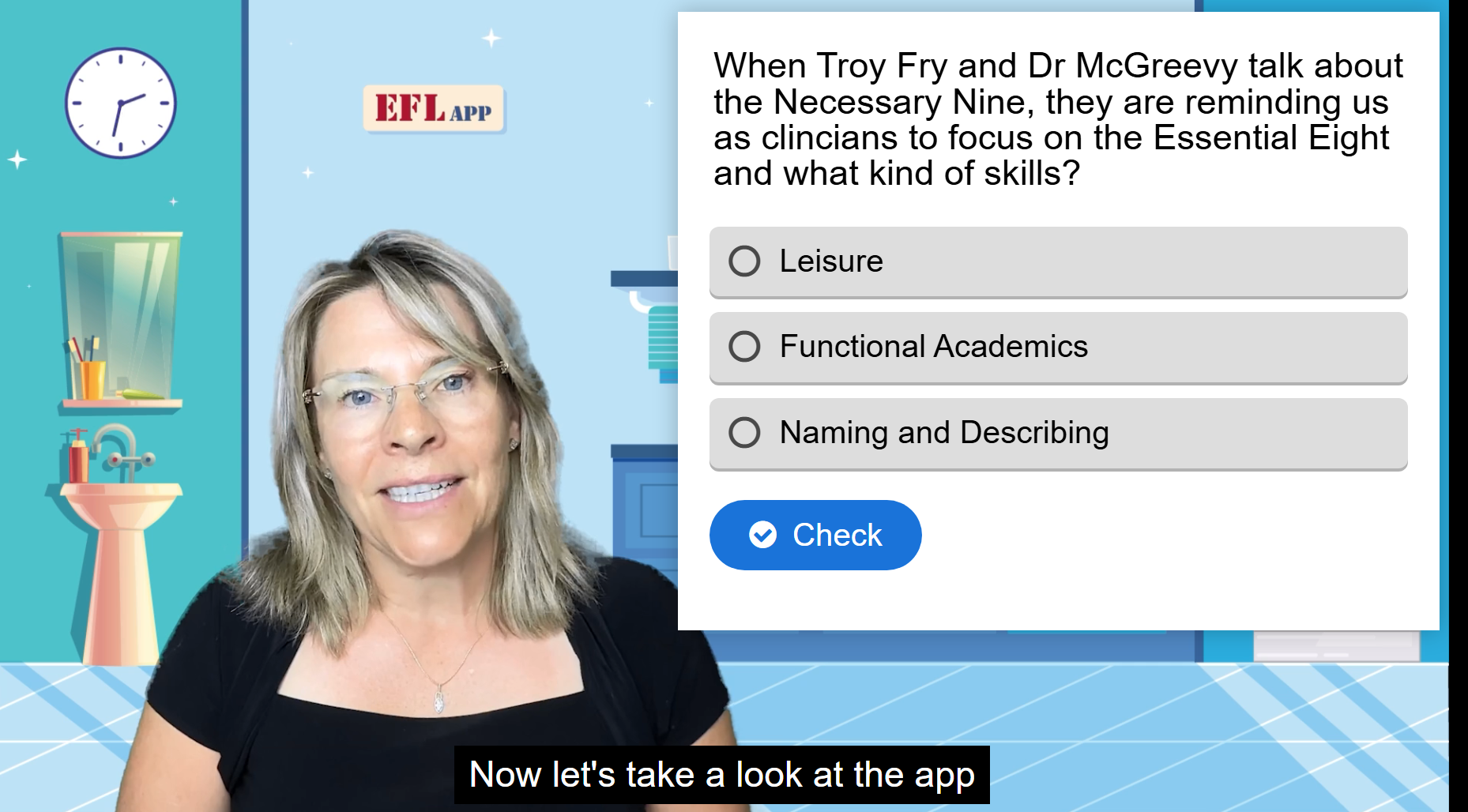 Lessons pause to check understanding as you go.
EFL 101 is built around short video lessons that stop and ask questions, so you find the gaps while you are learning rather than at the end.
Lessons pause at key moments and ask you to answer before continuing, so concepts land before the next one arrives.
Module quizzes require 100% to move on, and you can retake them as many times as you need. The goal is mastery, not a score.
Each section has its own discussion forum, so you can raise cases and questions with other practitioners as you work through it.
Work at your own pace. The course tracks where you are, so you can stop after one lesson and pick it up next week.
Six modules, bookended by a pre-test and a post-test. Every module ends with a quiz and a discussion forum.
A short pre-test establishes your starting point and unlocks the course content.
What Essential for Living is, who it serves, and the behavioural science it rests on.
The assessment toolkit end to end, from choosing a communication method to handling problem behaviour.
Turning assessment results into goals you can write down and protocols you can run.
Recording what a learner is acquiring, and using it to decide what to teach next.
A worked example that follows real learners through assessment, teaching and progress.
Putting the framework into practice in the app you will use day to day.
An 80% score completes the course. Attempts are unlimited, so you can revisit the material and try again.
Add your BCBA certification ID during the course and download a CEU certificate once you have passed.
Every participant who completes the post-test receives a certificate for the EFL 101 and the EFL App course.
Module quizzes require 100% and the post-test requires 80%. Retakes are unlimited, so the bar stays high without being a gate.
EFL 101 assumes no prior experience with Essential for Living, and moves fast enough to stay useful if you have some.
Ground the framework in ABA and Skinner's analysis of verbal behavior, and earn CEUs while you do it.
Write IEP and ISP goals that come straight out of the assessment, and run teaching protocols with confidence.
Work through vocal profiles and alternative methods of speaking so communication decisions are grounded in data.
Understand what is being assessed and why, so you can carry the same approach into daily routines at home.